How to Deal with a Mean Nurse or Bullying Clinical Instructor: A Survival Guide for Nursing Students
Why a Mean Nurse or Bullying Clinical Instructor Can Derail Your Nursing Clinicals
Almost every nursing student has a story about a mean nurse. A staff nurse may have rolled her eyes when you asked where the linen cart was. A bullying clinical instructor may have corrected you loudly in front of a patient and their family. The phrase "nurses eat their young" has been around for decades. Most nurses are supportive, but the ones who are not can make nursing clinicals feel like a place you dread instead of a place you learn.
It helps to understand where this behavior comes from, even though understanding it does not excuse it. Staff nurses often juggle heavy patient loads, short staffing, and pressure from management, so a student following them around can feel like one more task. Some instructors were trained under a "sink or swim" model and believe harshness builds competence. Others are simply stressed, burned out, or poor communicators. Researchers call this pattern lateral violence, or horizontal hostility. It includes eye-rolling, sarcasm, withholding information, public criticism, and leaving someone out.
This matters because fear shuts down learning. When you are anxious about being criticized, you hesitate to ask questions, you miss cues in your assessment, and you make more mistakes. If you are already stretched thin, our step-by-step survival guide for overwhelmed nursing students is a good companion to this article. The goal here is to help you protect your learning, your future license, and your confidence without burning bridges.
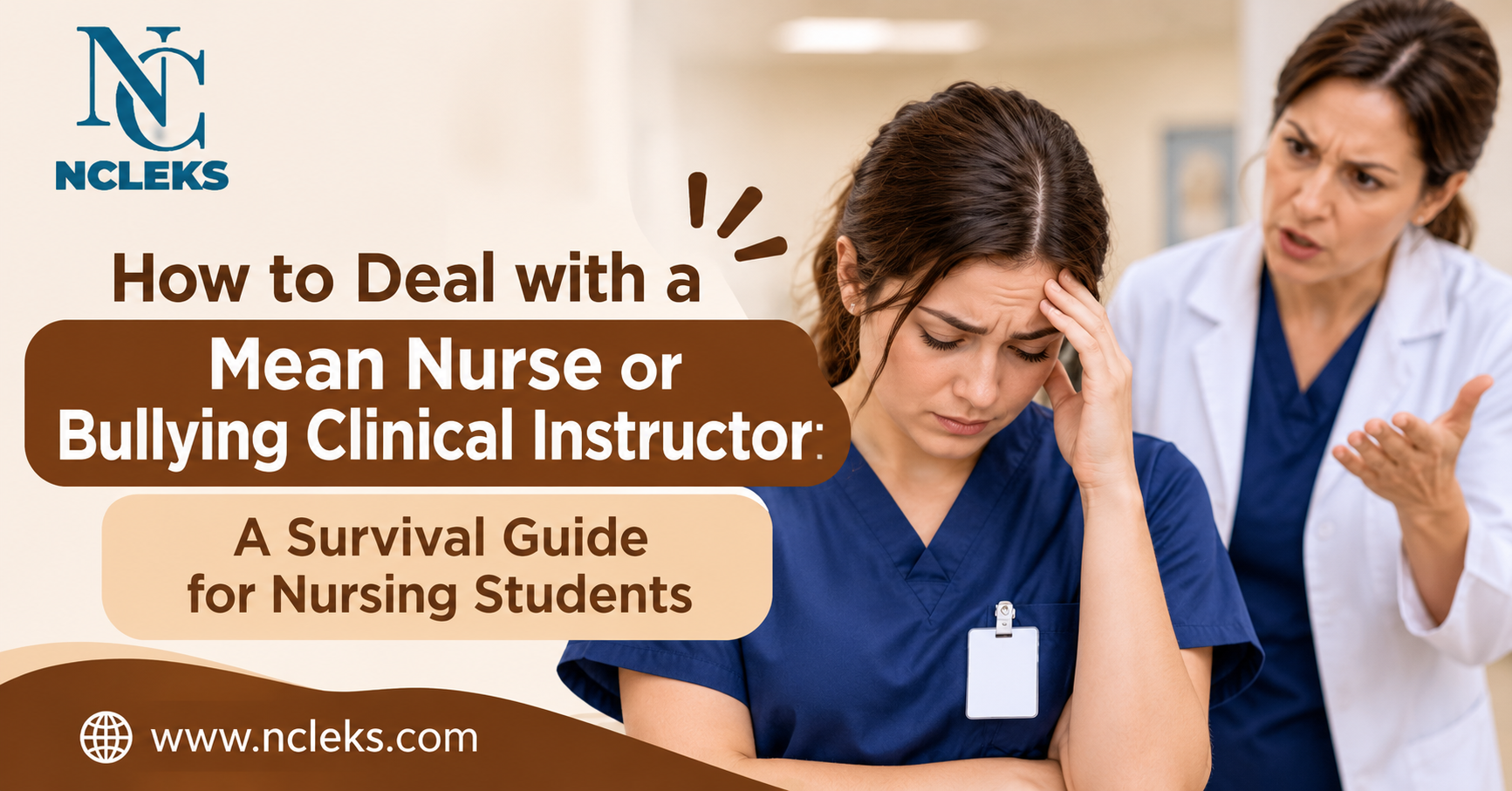
Tough Feedback vs. True Bullying: Learning to Tell the Difference
Before you label someone a mean nurse, take an honest look at what is happening. Not every blunt comment is bullying. Clinical instructors are responsible for patient safety. If you are about to give a medication without checking the armband, a sharp "Stop" is appropriate. Direct, specific feedback about your skills is part of becoming a safe nurse, even when it stings.
Bullying looks different. It is repeated, it targets you as a person rather than your performance, and it does not help you improve. A bullying clinical instructor might:
- mock you in front of your peers,
- give vague criticism like "You just aren't nursing material" with no examples,
- Assign you harder tasks than your classmates as punishment, or
- threaten your grade for asking a question.
A staff nurse who bullies might refuse to give you a report, ignore you when you ask for help, or tell patients you are not competent.
A useful test is to ask yourself three questions. Was the comment about a specific behavior I can change? Was it delivered privately or for a real safety reason? Is this a pattern, or a single bad moment on a hard shift? If the answers point toward repeated personal attacks, you are likely dealing with bullying rather than high standards.
Check your own preparation as well. Showing up late, unprepared, or without your equipment invites harsher treatment from anyone. Review our checklist of what to bring to nursing clinicals and make sure you are meeting baseline expectations first.

How to Respond in the Moment Without Making It Worse
When a mean nurse snaps at you mid-shift, your first job is to stay calm and keep the patient safe. Take a breath, lower your voice, and avoid arguing in the hallway or at the bedside. Patients notice tension, and a public confrontation rarely ends well for the student.
Use professional, assertive communication. The "I" statement is one of the most effective tools you have. For example: "I want to make sure I do this correctly. Can you show me what I missed?" This moves the conversation away from blame and toward learning. It is hard for someone to keep attacking a person who is calmly asking to improve.
If a comment was personal, address it privately later. You might say: "Earlier, when you said I was useless in front of the patient, I felt embarrassed. I learn better when feedback is given in private. Can we do that going forward?"
Never let intimidation push you into unsafe practice. If a staff nurse tells you to do something outside your student role or to do it without your instructor present, politely decline. Say you need to check with your instructor first. Knowing your role protects you, and the principles you learn studying delegation rules for LPNs and UAPs on the NCLEX apply in real life too. The same goes for the reasoning in risk-based safety questions. Let it guide you whenever someone pressures you to cut corners during nursing clinicals.
Documenting and Reporting a Bullying Clinical Instructor
If the behavior continues, start writing things down. Documentation is your best protection when dealing with a bullying clinical instructor, because complaints without specifics are easy to dismiss. After each incident, record:
- the date, time, and location,
- the exact words used, as closely as you can remember them,
- who was present, and
- how the incident affected your learning or patient care.
Keep these notes on a personal device or in a notebook, not on school or hospital computers. Stick to facts rather than emotions.
Next, follow the chain of command. You will be tested on this principle on the NCLEX, and it applies here as well. If it feels safe, start with a private conversation with the instructor. If that does not work, take your documentation to your course coordinator or lead faculty member. Go to the program director or dean only if the problem is still not resolved.
For problems with a mean nurse on the unit, talk to your clinical instructor first. Your instructor can then speak with the charge nurse or nurse manager. Skipping steps can make it look like you are avoiding a fair resolution.
Check your student handbook for grievance procedures and deadlines, since many programs set firm time limits for grade appeals. Your school should also have anti-retaliation policies, so a legitimate complaint should not cost you your place in the program. If you are worried about being dismissed, read about what can actually get you dropped from a nursing program. If a clinical failure has already happened, our guide on what to do after failing a fundamentals course walks through appeals and next steps.

Turning a Difficult Clinical Rotation Into Growth
Sometimes you cannot change the person, so focus on what you can control: your performance and your preparation. Being overprepared leaves a bullying clinical instructor with less to criticize. When you can, look up your patients' medications, diagnoses, and lab values the night before. Practice your skills until they feel automatic.
A refresher on performing a thorough head-to-toe assessment can help. So can our tips for passing your simulation lab check-offs. Building real competence makes criticism less likely, and easier to handle when it does come.
Look for allies, too. Not every nurse on the unit will be hostile. Find the nurse who answers questions patiently and ask if you can follow them for a procedure. Lean on your classmates, because you are probably not the only one struggling with a particular mean nurse. Many schools also offer counseling services and peer mentoring. Using them is a sign of maturity, not weakness.
Finally, take mental notes on what not to do. Watching a nurse who treats students poorly shows you exactly what kind of nurse and preceptor you refuse to become. Years from now, a nervous student will be following you during nursing clinicals, and you will remember how much a kind word mattered.
Protecting Your Mental Health After a Hard Clinical Day
Repeated exposure to a mean nurse or a bullying clinical instructor can wear you down in ways you might not notice right away. Warning signs include trouble sleeping, dreading the night before clinically, crying in the car, or doubting whether you belong in nursing. These feelings are common, and they do not mean you are failing.
Build a deliberate routine that separates clinical stress from the rest of your life. Some students journal for ten minutes. Others call a friend on the drive home or go straight to the gym. Our article on how nurses can decompress on the way home shares practical ideas that work as well for students as for working nurses. Protect your sleep, eat real meals, and keep up the activities that remind you who you are outside of school.
If anxiety starts affecting your exams, remember that the skills you build handling pressure in nursing clinicals also apply to testing. Reviewing nursing test-taking strategies for clinical judgment and prioritization can help you feel more in control.
One exception to the step-by-step approach: if the behavior ever involves threats, discrimination, sexual harassment, or anything that makes you feel unsafe, do not wait. Report it immediately to your program director or your school's Title IX office.

How This Shows Up on the NCLEX: Conflict and Professional Communication
Conflict resolution, chain of command, and professional communication with colleagues all appear on the NCLEX under the Management of Care category. Questions may ask how a nurse should respond to a colleague's hostility, when to escalate a concern, or how to handle a request that falls outside safe practice.
The way you handle a mean nurse or a bullying clinical instructor during nursing clinicals mirrors the reasoning these questions test. First, stay professional and keep the patient as the priority. Second, address concerns directly and privately before involving others. Third, escalate through the proper channels only when direct communication fails.
Answer choices that ignore the problem, gossip about it, or jump straight to the highest authority are usually wrong. So are choices that respond with hostility. The correct choice is usually the one that is assertive, respectful, and focused on safety. Work through the practice questions below to apply what you have learned, and notice how each correct answer reflects calm, direct, safety-focused communication.


No comments yet. Be the first to comment!