Understanding the 2026 NCLEX-RN® Test Plan: A Complete Guide for Nursing Students
The NCLEX-RN® is more than just a nursing exam; it is the final gateway between nursing school and professional practice. Every question on the exam is carefully designed to determine whether a candidate can practice safely and effectively as an entry-level registered nurse. At the center of this process is the 2026 NCLEX-RN® Test Plan, which officially takes effect in April 2026 and serves as the blueprint for how the exam is built, administered, and scored.
For many nursing students, the test plan feels abstract or overwhelming, yet understanding it is one of the most effective ways to improve NCLEX preparation. Rather than studying blindly or relying solely on question banks, students who understand the structure, priorities, and intent of the test plan are better able to focus their efforts on what truly matters. This guide explains the 2026 NCLEX-RN® Test Plan in plain language, showing how it shapes the exam and how students can use it to study more strategically.
Why the 2026 NCLEX-RN® Test Plan Matters
The NCLEX-RN® Test Plan exists to protect the public. Its purpose is not to test how much information a student can memorize, but to determine whether a newly licensed nurse can make safe, sound clinical decisions in real-world settings. Every item on the exam is tied directly to the responsibilities and expectations of entry-level registered nurses.
The test plan is updated every three years to reflect changes in nursing practice, healthcare delivery, and patient needs. The 2026 version is grounded in a large-scale practice analysis that surveyed nearly 24,000 newly licensed registered nurses across the United States and Canada. These nurses reported how frequently they performed specific tasks, how important those tasks were, and how closely they were linked to patient safety. This data ensures that the exam remains relevant, practical, and reflective of actual nursing work.
For students, the test plan functions as a roadmap. It explains what content appears on the exam, how that content is organized, and why certain areas are emphasized more than others. When used correctly, it helps students prioritize their studying and understand what the NCLEX is really asking them to demonstrate.
How the NCLEX-RN® Test Plan Is Developed
The development of the NCLEX-RN® Test Plan is a structured, evidence-based process led by the National Council of State Boards of Nursing (NCSBN). The foundation of the test plan is the RN Practice Analysis, which examines the real-world activities of entry-level nurses. This analysis identifies which nursing behaviors are most common, most critical to safety, and most representative of early professional practice.
In addition to practice analysis data, expert input from nurse educators, clinicians, regulators, and psychometricians is incorporated. The NCLEX Examination Committee reviews proposed changes and ensures that the test plan aligns with nurse practice acts and regulatory standards across jurisdictions. Final approval comes from the NCSBN Delegate Assembly, making the test plan a nationally accepted standard.
This process ensures that the NCLEX-RN® is not an academic exam disconnected from practice, but a licensure examination grounded in patient care realities.
Core Beliefs Behind the 2026 NCLEX-RN® Test Plan
The test plan is built on foundational beliefs about people, health, and nursing. Clients are viewed as individuals, families, groups, and populations, each with unique values, beliefs, and needs. They have the right to participate in decisions about their care and to receive respectful, ethical treatment.
Nursing is defined as both an art and a science, integrating knowledge from biological, physical, social, and behavioral sciences. The registered nurse is accountable for delivering care that promotes health, prevents illness, manages disease, and supports dignity across the lifespan, including at the end of life.
These beliefs influence how questions are written. NCLEX items frequently emphasize ethical practice, patient autonomy, cultural sensitivity, and legal accountability, reflecting the professional responsibilities nurses carry from their first day of practice.
Cognitive Levels Tested on the NCLEX-RN®
The NCLEX-RN® does not focus on memorization. Instead, it emphasizes application and higher-level thinking. The exam is built using Bloom’s Taxonomy for the cognitive domain, with most items written at the application, analysis, or evaluation levels.
This means students are expected to interpret data, recognize patterns, prioritize care, and make decisions rather than recall isolated facts. For example, instead of asking for a definition, a question may present a patient scenario and ask what the nurse should do next to maintain safety.

Understanding this cognitive focus helps students adjust their study strategies. Simply reading notes or memorizing lab values is not enough; students must practice applying knowledge in clinical contexts.
Structure of the 2026 NCLEX-RN® Test Plan
The test plan is organized around a framework called Client Needs, which represents the universal responsibilities of nurses across all settings. This framework is supported by Integrated Processes and a strong emphasis on clinical judgment.
The four major Client Needs categories form the backbone of the exam. They ensure that content reflects both physical and psychosocial care, prevention and treatment, and individual and system-level responsibilities. Integrated Processes such as communication, teaching, and the nursing process are woven throughout all categories, rather than tested separately.
This structure reflects how nursing care is delivered in practice, where multiple skills and considerations are used simultaneously rather than in isolation.
The Four Major Client Needs Categories
The first category, Safe and Effective Care Environment, focuses on protecting patients and healthcare personnel. It includes management of care and safety and infection prevention. Questions in this category often address delegation, prioritization, legal responsibilities, confidentiality, infection control, and systems-based practice. These topics reflect the nurse’s role in coordinating care and maintaining a safe environment.
Health Promotion and Maintenance addresses growth and development, disease prevention, and health education across the lifespan. This includes prenatal and postpartum care, pediatric milestones, adult health screenings, and older adult considerations. Items in this category often test anticipatory guidance, screening recommendations, and patient education.
Psychosocial Integrity centers on emotional, mental, and social well-being. This category includes mental health disorders, coping mechanisms, substance use, grief, loss, and therapeutic communication. Questions often require students to recognize behavioral cues, assess emotional needs, and select appropriate interventions that support psychological safety.
The final category, Physiological Integrity, is the largest and most detailed. It includes basic care and comfort, pharmacological and parenteral therapies, reduction of risk potential, and physiological adaptation. This category covers medication administration, procedures, acute and chronic illness management, and responses to life-threatening conditions. Because physiological stability is critical to patient survival, this category makes up a significant portion of the exam.
Integrated Processes Across the Exam
Integrated Processes are fundamental nursing actions that appear throughout every Client Needs category. These include caring, communication and documentation, culture and spirituality, teaching and learning, and the nursing process.
Rather than appearing as separate sections, these processes are embedded into questions across the exam. For example, a medication question may also assess teaching, documentation, and cultural considerations. This reflects real nursing practice, where tasks are rarely performed in isolation.
Students who recognize these integrated elements can better understand why certain answer choices are correct, even when multiple actions seem reasonable.
Clinical Judgment and the NCJMM
Clinical judgment is a defining feature of the 2026 NCLEX-RN®. It is measured using the NCSBN Clinical Judgment Measurement Model (NCJMM), which describes clinical judgment as an iterative, multi-step process.
The six steps of the model include recognizing cues, analyzing cues, prioritizing hypotheses, generating solutions, taking action, and evaluating outcomes. These steps are assessed through both stand-alone questions and case studies. Case studies present unfolding scenarios that require students to make decisions as new information becomes available, closely simulating real clinical situations.

Clinical judgment questions may span multiple content areas, reinforcing the idea that effective nursing care requires synthesis rather than memorization.
Distribution of Content on the NCLEX-RN®
The percentage of questions assigned to each Client Needs category is based on practice analysis data and expert judgment. While the exact distribution may vary slightly due to computerized adaptive testing, the overall balance remains consistent.
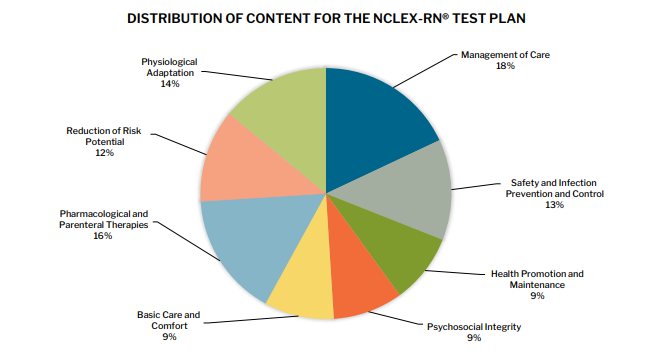
Because the NCLEX uses adaptive testing, no two exams are identical. However, every exam meets the test plan requirements, ensuring fairness and consistency across candidates.
NCLEX-RN® Exam Format and Administration
The NCLEX-RN® is administered using computerized adaptive testing (CAT). Each candidate receives a unique exam tailored to their ability level. The exam includes a minimum of 85 questions and a maximum of 150 questions, with a total testing time of five hours.
Some questions are unscored pretest items used to evaluate future exam questions. These items are indistinguishable from scored items, which is why students should treat every question as if it counts.
Exam length does not indicate pass or fail status. Some candidates pass with the minimum number of questions, while others pass after reaching the maximum.
How the NCLEX-RN® Is Scored
The NCLEX-RN® does not use percentage-based scoring. Instead, it measures a candidate’s ability relative to a predetermined passing standard. This standard represents the minimum level of competence required for safe entry-level nursing practice.
The computer continuously estimates the candidate’s ability as questions are answered. The exam ends when the system is confident that the candidate’s ability is either above or below the passing standard, or when the maximum number of questions is reached.
Understanding this scoring system helps reduce anxiety and reinforces the importance of consistent performance rather than perfection.
What the 2026 NCLEX-RN® Test Plan Means for Students
For nursing students, the test plan should be viewed as a study blueprint rather than a checklist. It highlights what the exam values most: safety, clinical judgment, prioritization, and real-world decision-making.
Students who align their study plans with Client Needs categories, practice clinical judgment questions, and focus on application rather than memorization are better prepared for the exam. Reviewing the test plan regularly helps students identify weak areas and adjust their preparation accordingly.
The 2026 NCLEX-RN® Test Plan reflects the realities of modern nursing practice. It emphasizes critical thinking, ethical responsibility, and patient safety across diverse settings. By understanding how the exam is structured and why content is organized the way it is, students can study more efficiently and approach the NCLEX with greater confidence.
Rather than asking, “What should I memorize?” the test plan encourages students to ask, “How should a safe, competent nurse think?” That shift in mindset is often the key to NCLEX success.


No comments yet. Be the first to comment!