QUESTION #1
Dosage Calculations
Dosage Calculations
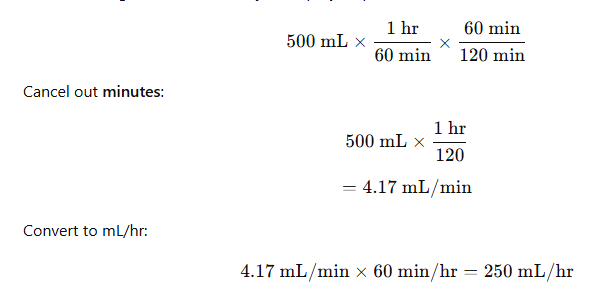
The doctor has ordered a 500 mL bolus to be infused over 120 minutes. What is the mL/hr the nurse will set the IV pump? Round the answer to the nearest whole number.
Explanations
A
A rate of 200 mL/hr would infuse the bolus over a longer period than the ordered 120 minutes.
B
This value represents under-infusion and would still exceed the prescribed 2-hour limit.
C
Dividing 500 mL by 2 hours gives exactly 250 mL/hr, matching the ordered infusion time.
D
A higher-than-calculated rate would cause the bolus to infuse faster than prescribed.
QUESTION #2
Dosage Calculations
Dosage Calculations
The client is prescribed Gentamycin 1.7 mg per kg. The client weighs 150 pounds. The supply is 10 mg/mL. How many mL(s) will the nurse administer? Round the answer to the nearest tenth.
Explanations
A
A dose this low would occur only if the client’s weight were underestimated during conversion from pounds to kilograms.
B
This amount results from rounding the weight or mg/kg value too early, producing a slightly lower volume.
C
Converting 150 pounds to 68.18 kg and multiplying by 1.7 mg/kg gives about 115.9 mg, and dividing by the 10 mg/mL concentration yields 11.6 mL after rounding.
D
A 12-mL dose would exceed the calculated requirement and results from rounding upward beyond the nearest tenth.
QUESTION #3
Dosage Calculations
Dosage Calculations
The APRN prescribed the client 250 mg Gentamycin PO TID. The safe dose range for Gentamycin is 3–5 mg/kg/dose. The client’s last recorded weight was 100 pounds. Calculate the safe dose range and determine if the medication is safe to administer. Round the answer to the nearest tenth.
Explanations
A
The range 100–200 mg does not match the calculated 3–5 mg/kg range for a 45.5-kg client and underestimates both the minimum and maximum safe dose.
B
Doses between 50 and 125 mg are below the calculated minimum safe dose of 136.5 mg, so while they would be non-therapeutic, the range itself is incorrect.
C
The numeric range is correct, but calling the ordered 250-mg dose “safe” is wrong because 250 mg exceeds the upper limit of 227.5 mg/dose.
D
The safe dose range for a 45.5-kg client is 136.5–227.5 mg/dose, and since the prescribed 250-mg dose is higher than 227.5 mg, the medication as ordered is considered unsafe.
QUESTION #4
Dosage Calculations
Dosage Calculations
A nurse practitioner prescribes Lithium 400 mg TID for a client with bipolar disorder. How many mg(s) will the client receive daily? Round the answer to the nearest whole number.
Explanations
A
This reflects giving the medication twice daily instead of three times, so the total is too low.
B
This amount does not match any correct multiplication of 400 mg across scheduled doses and underestimates the daily intake.
C
Three 400-mg doses total 1200 mg per day, which aligns exactly with the TID schedule.
D
This exceeds the calculated amount and is not supported by the prescribed frequency of dosing.
QUESTION #5
Dosage Calculations
Dosage Calculations
The doctor prescribes 1000 mL of D5 ½ NS at 120 mL/hr. How many hours and minutes will the fluids run? Round the answer to the nearest hundredth before calculating minutes. Round minutes to whole number (if applicable).
Explanations
A
A time this short results from rounding the decimal portion too far down and does not reflect the properly rounded 8.33-hour value.
B
Dividing 1000 mL by 120 mL/hr yields 8.3333 hours, which rounds to 8.33 hours, and converting 0.33 hours gives approximately 20 minutes, matching the required infusion time.
C
Landing at 25 minutes would require a decimal closer to 0.42 hours, which is not supported by the calculation.
D
Thirty minutes corresponds to a decimal of 0.50 hours, much higher than the actual rounded value of 8.33 hours.
QUESTION #6
Dosage Calculations
Dosage Calculations
The client has a headache and the doctor has prescribed Ibuprofen 600 mg to be administered PO Q6H PRN for pain. The recommended safe dose range for Ibuprofen is 5–10 mg/kg/dose. The client weighs 60 kg. Calculate the safe dose range and determine if the medication is safe to administer. Round the answer to the nearest whole number.
Explanations
A
The range 200–400 mg is too low compared with the recommended 5–10 mg/kg, so it underestimates how much ibuprofen can be safely given.
B
Multiplying 60 kg by 5 mg/kg and 10 mg/kg gives a safe range of 300–600 mg/dose, and the ordered 600 mg lies exactly at the top of this range, so it is still considered safe.
C
The upper limit of 1200 mg is much higher than the calculated 600-mg maximum, so this range would include unsafe overdoses.
D
Doses between 100 and 250 mg are below the minimum safe limit of 300 mg and would likely be subtherapeutic rather than within the recommended range.
QUESTION #7
Dosage Calculations
Dosage Calculations
The client was admitted with an MI. The client is to receive Aspirin 650 mg PO. In stock is Aspirin 325 mg. How many tablet(s) is the nurse going to administer? Round the answer to the nearest whole or half tablet.
Explanations
A
1 tablet supplies only 325 mg, which is half the required dose.
B
1.5 tablets provide 487.5 mg, still below the prescribed 650 mg.
C
2 tablets equal 650 mg, matching the ordered dose exactly and requiring no rounding.
D
2.5 tablets equal 812.5 mg, which exceeds the prescribed amount and would overdose the patient.
QUESTION #8
Dosage Calculations
Dosage Calculations
The MD orders cephalexin (Keflex) 1000 mg PO per day. The child weighs 36 kg. The recommended safe dose range is 25–50 mg/kg/day. Calculate the safe dose range (mg) and determine if the dose is safe to administer. (Round mg to the hundredth).
Explanations
A
The ordered 1000 mg/day is within the safe dose range of 900–1800 mg/day, meaning the prescription is appropriate for this child’s weight.
B
A dose is non-therapeutic only if it falls below 900 mg/day, which is not the case here.
C
A dose becomes unsafe when it exceeds 1800 mg/day. The ordered dose is well below this upper limit.
D
Clarification would be needed only if the ordered amount is outside the recommended safe dose range or if the order lacked essential details. Here, the dose is within range and clearly written, so no clarification is required.
QUESTION #9
Dosage Calculations
Dosage Calculations
A patient presents to the ED (Emergency Department) with chest pain. The cardiologist prescribes nitroglycerin IV at 15 mcg/kg/min. The pharmacy sends nitroglycerin 50 mg in 250 mL of D5W. Weight 112 lbs. Calculate the mL/hr the nurse should program the IV pump. Round to a whole number.
Explanations
A
A rate of 214 mL/hr corresponds to a lower mcg/kg/min dose than ordered and would under-treat the patient’s chest pain.
B
This setting still falls short of the calculated 229 mL/hr, so the patient would not receive the full prescribed nitroglycerin dose.
C
Although close, 225 mL/hr comes from rounding too early in the calculation and does not match the final rounded value.
D
Using the patient’s weight, the mcg/kg/min order, and the concentration (50 mg in 250 mL), the rate works out to 229.2 mL/hr, which rounds to 229 mL/hr.
QUESTION #10
Dosage Calculations
Dosage Calculations
The prescription is for vancomycin 1400 mg IV to infuse over 1 hour and be given every 12 hours. How many grams of vancomycin received in 24 hours. Round to nearest tenth.
Explanations
A
A daily total this low would occur only if fewer than two full 1400-mg doses were given.
B
This value falls short of the calculated 2800 mg/day and represents an underestimation of the total amount infused.
C
Two 1400-mg doses equal 2800 mg, which converts to 2.8 grams, matching the calculation exactly.
D
A 3-gram total exceeds the ordered amount and would require higher dosing than prescribed.
Want to See More Questions?
You've viewed your free preview! Create a free account or log in to access hundreds more practice questions, detailed explanations, and personalized study tools.
Unlimited access to all questions
Track your progress and performance
Create custom practice tests
Save questions for later review
Already have an account? Sign in here