Isolation Precautions NCLEX Questions: How to Get Them Right Every Time
Isolation precautions are one of the most tested topics, yet the most misunderstood. Many nursing students feel confident memorizing diseases, but struggle when faced with isolation precautions NCLEX questions that require clinical reasoning.
The good news is that once you understand how infections spread and how precautions are selected, these questions become predictable and much easier to answer. Mastering this topic not only helps you pass your first nursing school exam but also prepares you to protect patients, coworkers, and yourself in clinical settings.
Why Isolation Precautions Questions Matter on the NCLEX
Isolation precautions are an important part of safe nursing practice. On the NCLEX exam, these questions are designed to test how well you can protect patients, prevent the spread of infection, and make quick clinical decisions under pressure. Understanding what these questions mean will also help you approach them with the right mindset and build clinical reasoning for the most demanding class in nursing school.
Infection control is a major NCLEX testing category
Infection control falls under the safety and infection control category, one of the most tested areas on the NCLEX. Nurses play a crucial role in preventing the spread of infection, which is why they need to practice isolation precautions. These questions evaluate your ability to recognize infection risks, choose the correct personal protective equipment (PPE), and place patients in appropriate environments.
Also Read: What Does “Immediate Action” Mean on NCLEX?
In clinical settings, improper precautions can lead to outbreaks, longer hospital stays and serious patient complications. Due to this, infection control concepts are often linked to PPE selection, standard precautions and safety protocols. If you have studied PPE NCLEX questions or infection control NCLEX review, you’ll notice a strong overlap with isolation precautions content.
Why students commonly miss isolation precautions NCLEX questions
Many students struggle with these questions because they rely too much on memorization. While memorizing diseases helps, it can lead to confusion when similar conditions require precautions. A common mistake is mixing up diseases that require similar precautions, such as confusing droplet precautions with airborne precautions.
Another challenge is forgetting specific PPE requirements. For example, some students assume that every respiratory infection requires N95 mask, even when a surgical mask would be appropriate. Others forget important exceptions, such as the need to wash hands with soap and water instead of using sanitizer for C. difficile infections.
Understanding the Basics of Isolation Precautions
Isolation precautions are measures used to prevent the spread of infectious organisms from one person to another. They protect patients, nurses, and medication aides from infections. Understanding these precautions requires knowledge of how infections spread through contact, droplets, or airborne particles.
These precautions are divided into standard precautions and transmission-based precautions. Standard precautions are applied to all patients, regardless of diagnosis. Transmission-based precautions are added when a patient has a known or suspected infection that spreads in a specific way.
Understanding this foundation makes it easier to interpret the types of isolation precautions used in different clinical situations.
Standard precautions every nurse should know
Standard precautions are used for every patient encounter. They are considered the baseline level of protection and include practices such as hand hygiene and the use of gloves after performing a head-to-toe assessment.
Nurses must wash their hands before and after patient contact, after removing gloves, and whenever contamination is suspected. Gloves are worn when touching bodily fluids, and masks or eye protection are used when splashing is possible.
Many isolation precautions NCLEX questions include standard precautions as distractors, so understanding when they apply alone and when additional precautions are needed is critical.
A nurse is caring for a patient diagnosed with Clostridioides difficile (C. difficile) infection. Which precaution should the nurse implement?
Types of Isolation Precautions You Must Master
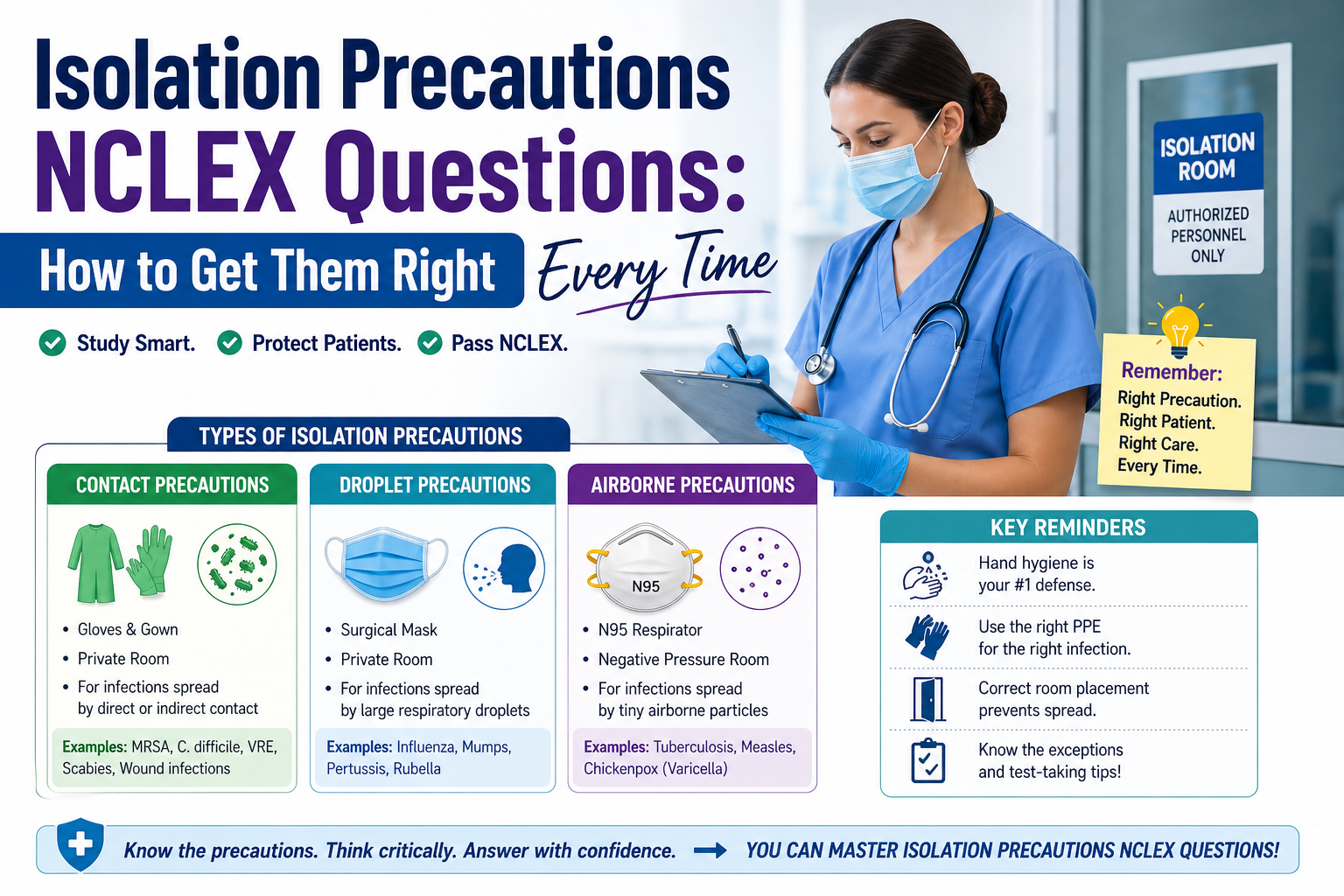
If you want to pass the NCLEX exams, you need to understand the types of isolation precautions and how they differ. Transmission-based precautions are additional safety measures used when standard precautions are not sufficient. They are classified into contact, droplet and airborne precautions.
Contact precautions
Contact precautions are used for infections spread through direct or indirect contact. Examples include MRSA, VRE and C. difficile. These organisms can survive on surfaces, equipment and hands.
Patients requiring contact precautions should be placed in private rooms when possible. Nurses are expected to wear gloves and gowns when entering the room and equipment such as blood pressure cuffs should be dedicated to the patient to prevent cross-contamination.
Important Tip: Remember C. difficile requires handwashing with soap and water instead of alcohol-based sanitizer.

Droplet precautions
Droplet precautions are used for infections spread through large respiratory droplets. These droplets typically travel short distances, usually less than six feet. Common examples include influenza, mumps, and pertussis. Nurses must wear surgical masks when entering the room, and patients should also wear masks during transport. Understanding droplet transmission helps clarify why masks are necessary, but negative-pressure rooms are not required.
Airborne precautions
Airborne precautions are used for infections spread through tiny particles that remain suspended in the air. Tuberculosis, measles and varicella are classic examples. Patients requiring airborne precautions must be placed in negative-pressure rooms and healthcare workers must wear N95 respirators before entering the room.
Because airborne infections pose a high risk of spread, they are often featured in isolation precautions NCLEX questions designed to test your understanding of advanced safety measures.
How Isolation Precautions NCLEX Questions Are Structured
Using Ncleks Nursing NextGen NCLEX-style practice questions allows you to anticipate what is being tested. Most isolation precautions NCLEX questions follow predictable patterns that assess clinical reasoning.
Patient scenario questions
Patient scenario questions often include clues about symptoms, diagnosis or exposure history. For example, a patient admitted with a persistent cough, weight loss and night sweats may indicate tuberculosis.
Your task is to recognize the disease and select the correct precaution. Many isolation precautions NCLEX questions follow this pattern because it reflects real clinical decision-making.
PPE selection questions
PPE questions test your ability to match equipment to infection type. For example, you may be asked what to wear before entering a patient’s room. Incorrect answers often include unnecessary equipment. For instance, choosing an N95 respirator for a droplet infection would be incorrect.
Room assignment questions
Room assignment questions require critical thinking. You may be asked which patient should be placed in a private room or which patients can share a room safely. These questions often include multiple diagnoses, making them more challenging. Understanding types of isolation precautions helps you eliminate unsafe options quickly.
Memory Tricks to Remember Isolation Precautions NCLEX Questions
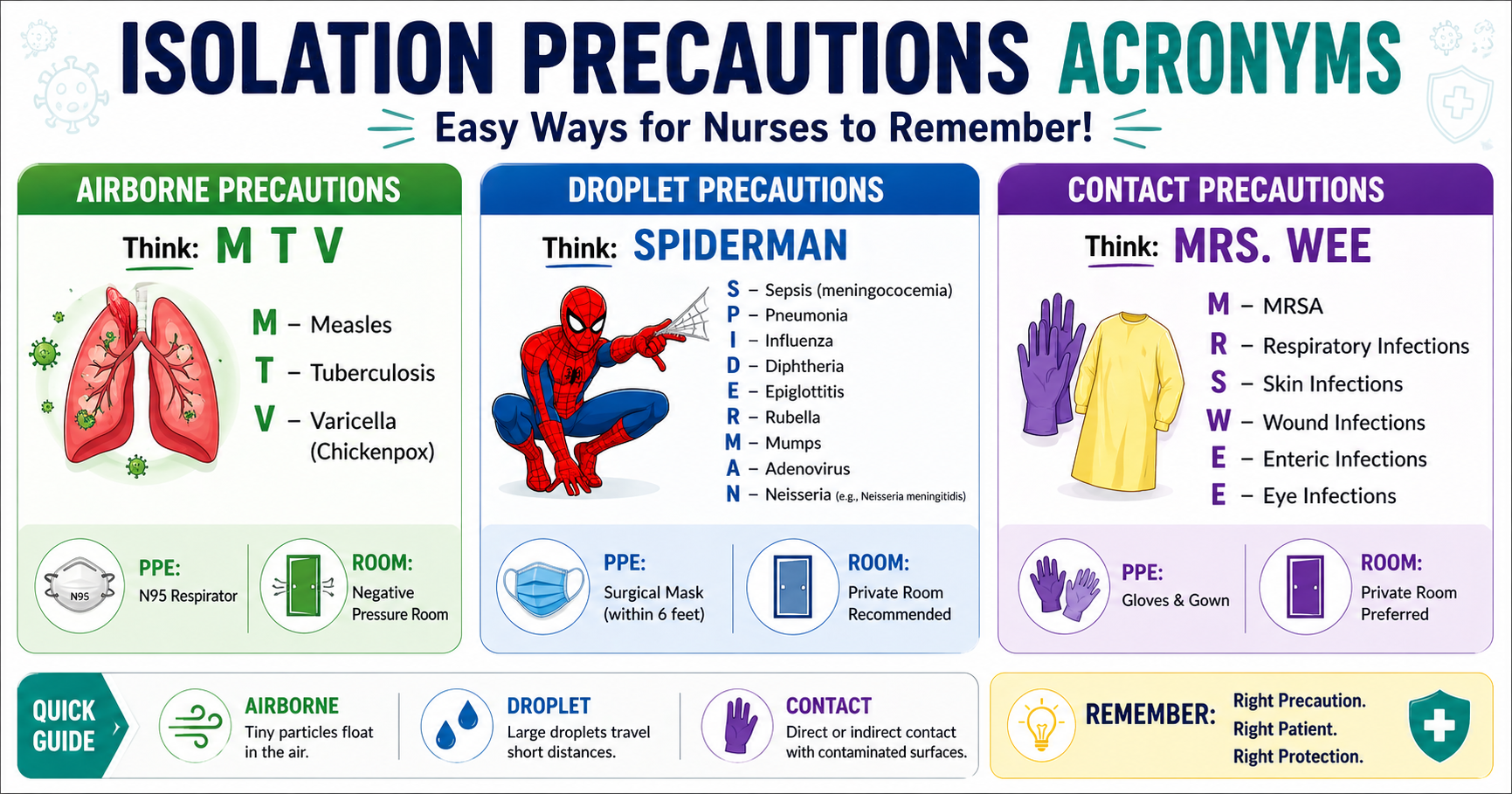
Memorization becomes easier when you use structured memory aids. For instance, acronyms help simplify complex information and improve recall during an exam.
Helpful acronyms
One well-known acronym for airborne precautions is MTV: measles, tuberculosis, and varicella. Droplet precautions can be remembered using SPIDERMAN, which includes diseases such as influenza and mumps.
Contact precautions are often remembered using phrases related to skin and wound infections. These memory tools simplify the process of recalling types of isolation precautions during stressful exams.
Step-By-Step Approach to Solving Isolation Precautions NCLEX Questions
A structured method makes isolation precautions NCLEX questions much easier to solve. Instead of guessing, you follow a logical sequence that mirrors clinical decision-making.
Step 1: Identify the disease or condition: Read the question to identify the diagnosis or symptoms. Many NCLEX questions provide direct disease names, but you can also get clues through symptoms or patient history. Recognizing the disease quickly is the foundation for solving isolation precautions NCLEX questions correctly
Step 2: Determine the mode of transmission: After identifying the likely disease, determine how the infection spreads. This step connects directly to understanding the types of isolation precautions. When you match the disease to the transmission type, you have already cracked the important aspects of the question.
Suggested For You: How Many Times Can You Take the NCLEX? State-by-State Breakdown
Step 3: Choose correct PPE: Once transmission is identified, select PPE that protects against that specific mode of spread. You should avoid selecting extra PPE that is unnecessary.
Step 4: Consider room placement: Room placement is a common testing point and often determines the correct answer. Determine if the symptoms warrant a private room, a negative-pressure room or if the patient can safely share a room with another patient.
Step 5: Double-check for exceptions: Some infections have unique rules that appear frequently on exams. Missing these exceptions can lead to incorrect answers, even when the transmission type is correct.
Practice Tips to Master Isolation Precautions NCLEX Questions
Practice is the most effective way to build confidence. Instead of reviewing isolation precautions occasionally, make them part of daily study routines.
Start by reviewing disease lists and matching them to their correct precautions. Focus on understanding why certain precautions are used rather than memorizing them blindly.
Start using the Ncleks Nursing flashcards to test yourself, including the disease, the type of transmission, and the required PPE. This method reinforces long-term retention. Practice tests in isolation precautions NCLEX questions are effective in preparing for the board exams within 30 days. Reading rationales after answering questions helps you understand mistakes and correct misunderstandings.

No comments yet. Be the first to comment!