Nursing Informatics for Students: How to Read and Apply Clinical Data
What Nursing Informatics Means for Nursing Students
You practice nursing informatics every time you open a patient chart, scan a medication barcode, or glance at a vital sign graph. The American Nurses Association describes nursing informatics as the specialty that combines nursing science with information and analytical sciences. Its purpose is to identify, manage, and communicate data, information, knowledge, and wisdom in nursing practice. That definition sounds abstract. For a student, it comes down to one practical skill: finding the right clinical data, understanding what it means, and acting on it safely.
Many students assume informatics belongs to hospital IT departments. In reality, every bedside nurse is a data user. You will collect assessment findings and enter them into the electronic health record (EHR). You will review lab and radiology results and report changes to providers. Each of those steps depends on accurate data moving through the system.
A helpful framework is the data, information, knowledge, wisdom continuum. Here is how it works with a single lab result:
Data: A potassium value of 3.1 mEq/L.
Information: Recognizing that the value is low.
Knowledge: Knowing that low potassium raises the risk of dysrhythmias, especially in a patient taking digoxin.
Wisdom: Holding the digoxin dose and notifying the provider.
Nursing programs and the NCLEX are both designed to move you along that continuum. The sooner you start reading charts this way, the stronger your clinical judgment becomes.
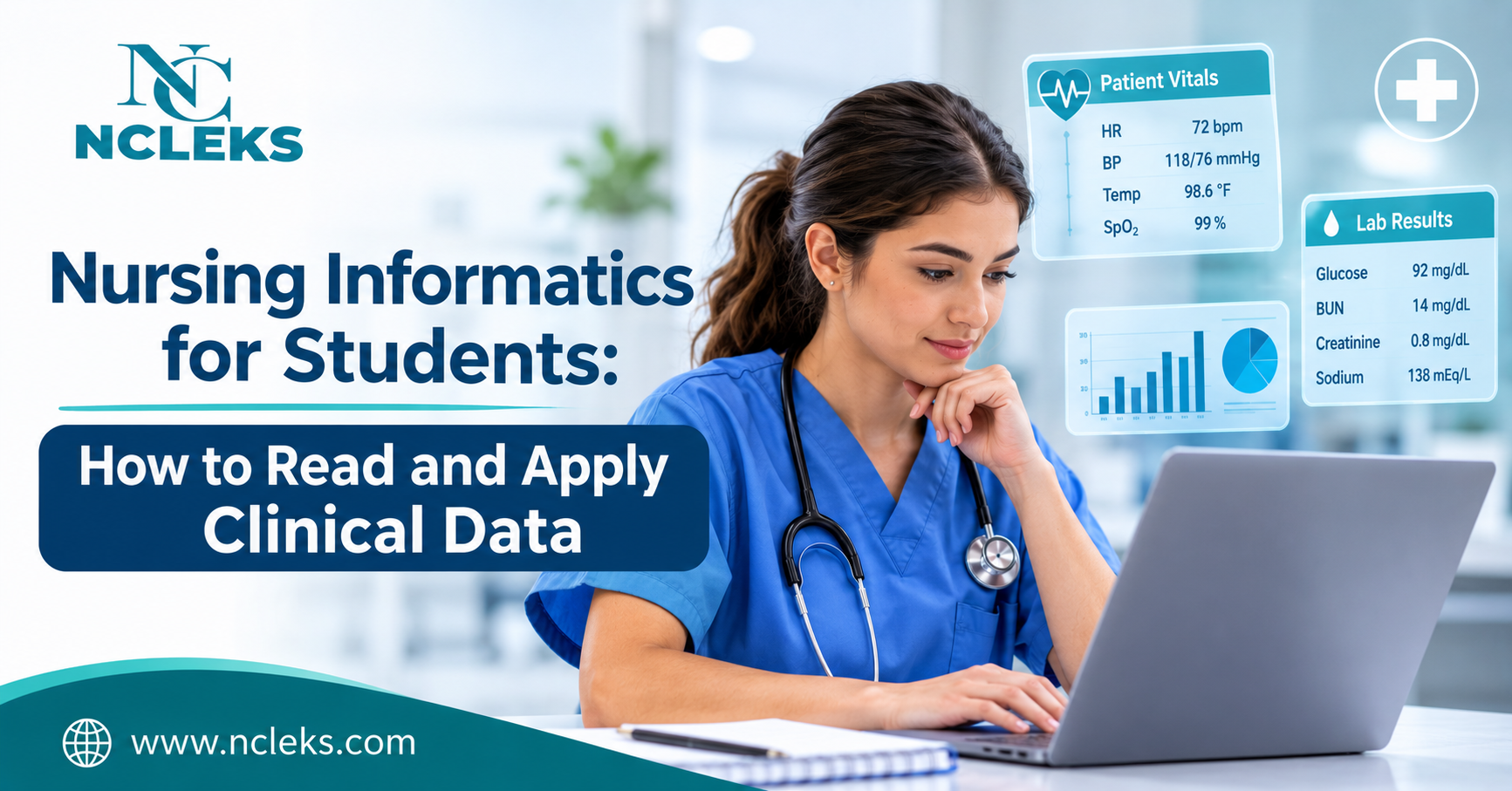
Navigating the Electronic Health Record During Clinicals
Your first login to a hospital's electronic health record can feel overwhelming. Epic, Oracle Health (formerly Cerner), and Meditech each organize information differently, but most share the same core areas:
Patient banner: A summary strip at the top of the chart.
Medication administration record (MAR): Scheduled and as-needed medications.
Flowsheets: Vital signs and assessment documentation.
Results: Labs and imaging.
Orders and notes: Provider orders and notes from the interdisciplinary team.
Learning where each of these lives is the first step toward reading a chart efficiently.
Start every shift with the patient banner. It usually shows the patient's name, age, code status, allergies, isolation status, and fall risk. Missing an allergy flag or isolation alert is a safety error, so check this area before you walk into the room. Next, review active orders and the MAR so you know what is due and when. Then scan recent results and the last 24 hours of vital signs before reading the latest provider and nursing notes.
Student access is often limited. Some facilities let students document assessments with an instructor or nurse cosign, while others restrict medication documentation entirely. Ask your clinical instructor about the rules on day one. It also helps to prepare ahead; our guide on what to bring to nursing clinicals covers tools like a report sheet that pairs well with chart review. If you have trained in the nursing simulation lab, you may have already used an academic EHR, which makes the real system feel more familiar.
How to Read Clinical Data: Trends, Labs, and Flowsheets
The most important rule for reading clinical data is simple: trends matter more than single values. A blood pressure of 100/60 mmHg may be normal for one patient and alarming for another whose baseline is 150/90. EHR flowsheets and graphing tools let you view vital signs over hours or days, so use them. A heart rate that climbs from 82 to 112 over three readings tells a far more urgent story than any one number.
When reviewing labs, compare the current value to both the reference range and the patient's previous results. Suppose a patient's hemoglobin dropped from 12.5 g/dL yesterday to 9.0 g/dL today. That drop suggests possible bleeding, even though some patients with chronic conditions live comfortably near 9.0. Pay attention to critical value flags, but do not rely on them alone. A value can sit within the normal range and still be moving in a dangerous direction. Our walkthrough on answering NCLEX lab value questions reviews the ranges you are most likely to see tested.
Context is the final piece. Always connect the numbers to the patient in front of you. Intake and output records, daily weights, pain scores, and medication times often explain why a value changed. A rising creatinine with falling urine output points toward kidney injury. A dropping blood glucose shortly after scheduled insulin has an obvious explanation. Pair your chart review with a thorough head-to-toe assessment to confirm that the clinical data on the screen matches what you see, hear, and feel at the bedside.
Turning Clinical Data Into Clinical Judgment
Reading the chart is only half the job. The real skill in nursing informatics is using what you find to make decisions. The NCSBN Clinical Judgment Measurement Model, which shapes the Next Generation NCLEX, describes six cognitive steps: recognize cues, analyze cues, prioritize hypotheses, generate solutions, take action, and evaluate outcomes. Each step relies on clinical data from the chart and the bedside.
Consider a postoperative patient whose EHR shows these findings: temperature rising from 37.2 to 38.6 degrees Celsius, heart rate 118, respiratory rate 24, and white blood cell count 15,000/mm³.. Here is how the six steps apply:
Recognize cues: Notice the abnormal values.
Analyze cues: See that, taken together, they suggest sepsis.
Prioritize hypotheses: Decide that sepsis is more urgent than simple postoperative inflammation.
Generate solutions and take action: Notify the provider, anticipate blood cultures and a lactate level, and prepare for fluids and antibiotics per protocol.
Evaluate outcomes: Recheck the data after interventions.
This process mirrors the familiar nursing process (ADPIE), just in more detail. Practicing it during clinicals also teaches you to tell a patient who can wait from one who needs you now, a skill covered in our guide to stable versus unstable patients. Many hospitals build early warning scores into the electronic health record, combining vital signs into a single risk number. These tools support your judgment; they do not replace it.

Documentation, Privacy, and Safety Technology in Nursing Informatics
Informatics is not only about reading data; it is also about creating it. Everything you document becomes clinical data that other team members rely on, so accuracy and timeliness are essential. Chart objectively, record what you actually assessed rather than what you expected to find, and document care as close to the time it happened as possible. Never document an assessment or medication before it happens. If you make an error, follow the facility policy for corrections in the electronic health record. You cannot simply delete an entry because the system keeps an audit trail.
Privacy is equally important. Under HIPAA, you may access only the records of patients assigned to your care and only the information that care requires. Looking up a classmate, family member, or celebrity patient is a violation that can lead to dismissal from your program. Log out whenever you step away from a workstation, never share your password, and never photograph screens or take printed records home.
Nursing informatics also includes safety technology such as barcode medication administration, smart infusion pumps, and clinical decision support alerts. Barcode scanning helps verify the rights of medication administration, but a scan is not a substitute for thinking. If the system flags a dose, or a patient's heart rate or potassium makes you question an order, pause and investigate. Our article on when to hold a medication explains common hold parameters, and our guide to risk-based NCLEX questions shows how safety thinking is tested. Avoid alert fatigue by reading every warning instead of clicking past it.
How Nursing Informatics Appears on the NCLEX
The NCLEX has no separate informatics section, but informatics concepts run throughout the test plan. Under Management of Care, expect questions about confidentiality, information technology, documentation, and appropriate use of the electronic health record. Under Safety and Infection Control, barcode scanning and error prevention appear regularly. Reviewing the 2026 NCLEX-RN test plan shows exactly where these topics fit.
Next Generation NCLEX case studies are the clearest example of informatics on the exam. These items present a simulated chart with tabs for nurses' notes, vital signs, laboratory results, admission notes, and orders. You must sift through that clinical data, decide which findings are relevant, and choose what to do. Students who have practiced chart review during clinicals tend to move through these items faster. They already know how to scan for abnormal trends instead of reading every line word for word. Our breakdown of NextGen NCLEX case study questions walks through this approach step by step.
A smart strategy is to read the question first, then scan the chart tabs for findings that relate to it. Mentally flag values that are abnormal, have changed, or conflict with the patient's history. This is the same workflow a nurse uses at the start of a shift. That is why strong nursing informatics habits translate directly into better NCLEX performance.

Building Nursing Informatics Skills Before Graduation
You don't need a computer science background to feel comfortable with nursing informatics. Start by treating every clinical day as chart practice. Before reporting, try to identify the three most important abnormal findings for each patient using only the electronic health record. Then check with your instructor or primary nurse to see if they agree. Over time, you will find information faster and recognize patterns sooner.
Outside of clinicals, practice reading clinical data in question form. NCLEX-style case studies, lab value drills, and the practice exams and flashcards on NCLEKS give you the same kind of chart-based reasoning. Pay attention to why each wrong answer is wrong, especially when the mistake involves misreading a trend or overlooking a key value.
If nursing informatics sparks your interest, know that it is also a career path. Nurse informaticists help design electronic health record workflows, train staff, and analyze outcomes data to improve patient safety. Most roles require bedside experience first, and many nurses later earn certification or a graduate degree.
For now, focus on the fundamentals:
Verify the data before you act on it.
Look for trends rather than single values.
Connect numbers to the patient at the bedside.
Protect privacy every time you log in.
Students who master these habits walk into the NCLEX and their first job, already thinking like nurses who can turn clinical data into safe, confident care.

No comments yet. Be the first to comment!