What’s the Difference Between “First” and “Best” on NCLEX Questions?
Do you find it challenging to differentiate between “First” and “Best” on NCLEX Questions? You are not alone. Truthfully, mastering the art of clinical judgment is the single most important hurdle you will face as you prepare for your licensure exam.
When you sit down for the test, you will realize that the challenge isn't just knowing the medical facts—it is knowing which fact to use when the clock is ticking. One of the most common stumbling blocks for students is the subtle, yet massive, distinction between being asked for the "first" action versus the "best" action. Understanding the nuances of first vs best NCLEX questions is what separates a student who knows the material from one who knows what it entails to be a nurse.
In this guide, we will break down these two distinct logic paths. You will learn how to shift your mindset from a student who memorizes lists to a nurse who prioritizes care. If you want to stop feeling like every answer choice is "technically correct" and start identifying the one that is "NCLEX correct," read on to master the most imperative NCLEX priority question tips.

Decoding the Language of Priority in First vs Best NCLEX Questions
The Psychology of the Exam
The National Council of State Boards of Nursing (NCSBN) recently implemented the Next Generation NCLEX (NGN) to better evaluate "clinical judgment." This isn't just a buzzword; it is a response to industry data. For instance, a 2024 report by the National League for Nursing (NLN) indicates that nearly 80% of new nurse errors stem from a failure to prioritize clinical tasks correctly amid shifting patient conditions. This is why the exam is designed to trip you up with multiple "good" options. When you encounter first vs best NCLEX questions, the test is looking for your ability to organize your brain according to the hierarchy of safety.
Defining the "First" Action in First vs Best NCLEX Questions
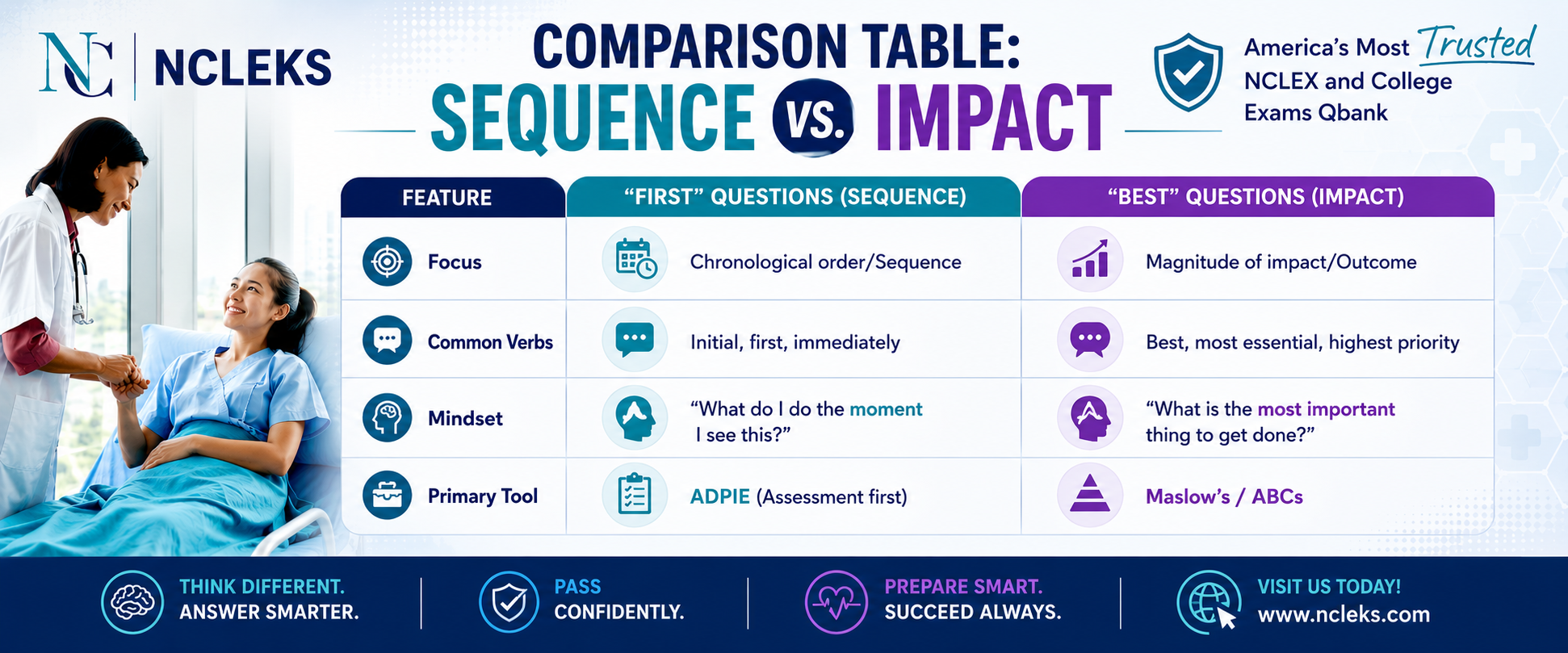
When a question asks you what you should do "first" or what your "initial" action should be, it is looking for a sequence. This is a chronological question. You must ask yourself: "If I am standing at the bedside and I can only do one thing before I leave the room to get help or supplies, what is the very first thing my hands should do?" Often, the "first" action is an assessment or a safety measure that sets the stage for everything that follows. Using NCLEX priority question tips helps you realize that the first action is the gateway to the rest of the nursing process.
Defining the "Best" Action in First vs Best NCLEX Questions
When a question asks for the "best," "most essential," or "highest priority" action, it is asking for the "money" answer. This is the action that will most directly resolve the patient's problem or prevent them from dying. It might not be the thing you do first in real life, but it is the most significant intervention in the plan of care. In first vs best NCLEX questions, the "best" answer is the one with the greatest impact on the patient's ultimate outcome.

The "First" Logic: Sequencing and Assessment
The Nursing Process as Your Compass
As an aspiring nurse, you are likely conversant with the nursing process (ADPIE). In first vs best NCLEX questions, ADPIE is your best friend. Most "first" questions want you to assess before you act. If you don't have enough data to move forward, your first step is to gather it. For example, if a patient reports sudden chest pain, your first action is to assess the patient's vital signs and pain characteristics because you cannot treat what you haven't fully measured.
When Assessment is Not First
One of the most valuable tips for answering first vs best NCLEX questions is knowing when to skip the assessment. If the question already provides the assessment data—such as a note stating the patient's heart rate is 140, and they are diaphoretic—you do not need to reassess. You have the data. Now, your "first" action moves to "Implementation." If the patient is in distress, "first" might mean a life-saving physical maneuver, like opening an airway or stopping a hemorrhage.
Chronological Safety in First vs Best NCLEX Questions
Think of "first" as the most immediate safety intervention. If a patient is falling, you don't stop to assess their blood pressure; you first ease them to the floor. In the context of first vs best NCLEX questions, "first" is about immediate containment and safety. It is the initial step in a protocol that protects the patient from immediate harm before more complex interventions can take place.
Also Read: Digoxin NCLEX Questions That Every Nurse Must Know

The nurse is reviewing the electronic health record (EHR) for a patient with heart failure. The EHR shows a heart rate of 124 bpm, respirations of 28/min, and an oxygen saturation of 87% on room air. The nurse enters the room and observes that the patient is gasping for air. What is the first action the nurse should take?
The "Best" Logic: Impact and Resolution
The "Life-Saving" Intervention
When you are looking for the "best" answer when answering first vs best NCLEX questions, you are looking for the intervention that solves the underlying crisis. According to 2025 clinical safety trends published by the Agency for Healthcare Research and Quality (AHRQ), "best" interventions are increasingly defined as those that address the "root cause" of physiological instability rather than just the symptoms. In an anaphylactic shock scenario, while you may stop an infusion first, the best action is to administer Epinephrine because it is the only thing that will actually reverse the life-threatening condition.
While assisting a patient to the bathroom, the nurse feels the patient’s knees buckle and their weight shift forward. Which action should the nurse take first?
Using Maslow’s Hierarchy
In first vs best NCLEX questions, Maslow’s Hierarchy of Needs is a powerful tool for finding the "best" answer. Physiological needs like oxygen, fluids, and electrolytes always trump safety and security. If you have four correct nursing actions, the best one is the one that maintains the patient’s physiological integrity. This is one of those NCLEX priority question tips that you will use on almost every page of the exam to filter out secondary concerns.
A patient is experiencing an acute anaphylactic reaction after an antibiotic dose. The nurse has stopped the infusion and called for help. Which intervention is the best action for the nurse to take?
The "If You Could Only Do One" Test
If you are struggling to find the "best" answer in first vs best NCLEX questions, use this mental trick: "If I could only do one thing on this list and then I had to go home and leave the patient alone for eight hours, which action would keep them alive?" The answer to that morbid question is usually the best nursing action. It identifies the core intervention that provides the highest degree of patient safety and clinical resolution.

The nurse is prioritizing care for four patients. Which patient should the nurse see first?
Comparing the Two Minds: First vs Best NCLEX questions
The nurse is assigned to a patient who has just returned from a thyroidectomy. Which action is the best precaution for the nurse to take to ensure patient safety?
The ABC Strategy in First vs Best NCLEX Questions
Whether the question asks for first vs best NCLEX questions, you must always apply the ABCs (Airway, Breathing, Circulation). An airway problem is almost always both the first and best thing to address. However, if the patient is already breathing but their heart has stopped, the best action is chest compressions, while the first action might be calling a "Code Blue" to get help on the way.
Suggested: 7 Smart Strategies to Secure Nursing School Scholarships (Even Without Perfect Grades)
Advanced Strategies for Priority Questions
Eliminating "Non-Nursing" Actions
A common trap in first vs best NCLEX questions is the "Call the Doctor" option. While you will certainly notify the physician, it is rarely the first or best thing for a nurse to do. The NCLEX wants to know what you can do within your scope of practice. Before you pick up the phone, ensure you have assessed the patient or provided an immediate safety intervention to stabilize the situation.
The nurse is applying the ABC strategy to prioritize a group of patients. Which findings represent a high priority for intervention? Select All That Apply.
Focusing on "Expected" vs. "Unexpected" in First vs Best NCLEX questions
A 2026 insight from the American Nurses Association (ANA) highlights that "priority" is often determined by whether a finding is expected for a specific diagnosis. If a patient is post-op and has pain, that is expected. If a patient is post-op and has a sudden sense of impending doom, that is unexpected and becomes your best focus for intervention. Using these NCLEX priority question tips will help you filter out the normal distractions of a clinical day.
A patient’s condition is rapidly deteriorating, and the nurse suspects a pulmonary embolism. Which actions should the nurse take before notifying the healthcare provider? Select All That Apply.
Real-World Application: Hypoglycemia Case Study
To see first vs best NCLEX questions in action, let’s look at a patient with a blood glucose of 45 mg/dL who is conscious. The first action is to verify the level and immediately give 15 grams of simple carbs using the 15-15 rule. The best action, however, is to ensure the patient's blood sugar returns to a safe range and provide a complex carb/protein snack to prevent a second crash. In this scenario, the first is the immediate rescue, but the best includes the stabilization that ensures the patient doesn't end up back in a crisis thirty minutes later.
Which assessment findings should the nurse prioritize as unexpected and requiring immediate intervention? Select All That Apply.
Integrating Clinical Judgment with Technology
When you join the nursing workforce, you will notice that technology is changing how we prioritize. Electronic Health Records (EHRs) now use predictive analytics to flag priority patients before they even show symptoms. However, as an aspiring nurse, you cannot rely solely on the machine. The NCLEX doesn't test your ability to use software; it tests your ability to think. Even with AI-assisted prioritizing, you are the one who must decide the first vs best NCLEX questions at the point of care. Thus, your clinical eye is the ultimate best tool in the hospital.
The nurse is managing a conscious patient with a blood glucose of 48 mg/dL. Which interventions represent the best comprehensive management of this event? Select All That Apply.
Start Transitioning from Student to a Competent Nurse
The secret to passing the NCLEX isn't just knowing the right answer—it's knowing the most accurate answer. By applying these NCLEX priority question tips, you are training your brain to see the patient through the lens of safety and physiological survival. Whether you are identifying the first sequence or the best outcome, you are practicing the very clinical judgment that will make you a successful licensed professional.
When you sit for your exam, take a breath every time you see a priority word. Ask yourself whether this is a timing question regarding what comes first or a value question regarding what is best. Once you identify the type of question, the correct answer will often jump off the screen at you.
Most importantly, keep your ABCs at the forefront, remember your standardized values, and trust the nursing process. You have the knowledge and the time-tested strategy to ace all first vs best NCLEX questions.
The nurse is using a bedside clinical decision support system (CDSS) that flags a patient as "High Risk for Sepsis." How should the nurse proceed? Select All That Apply.

No comments yet. Be the first to comment!